Friday, March 14, 2014

"If the wicked man turns away from all the sins"

... he committed, if he keeps all my statutes and does what is right and just, he shall surely live, he shall not die.

"Sins can be distinguished according to their objects, as can every human act; or according to the virtues they oppose, by excess or defect; or according to the commandments they violate. They can also be classed according to whether they concern God, neighbor, or oneself; they can be divided into spiritual and carnal sins, or again as sins in thought, word, deed, or omission. The root of sin is in the heart of man, in his free will, according to the teaching of the Lord: 'For out of the heart come evil thoughts, murder, adultery, fornication, theft, false witness, slander. These are what defile a man.' But in the heart also resides charity, the source of the good and pure works, which sin wounds." (CCC 1853)

Friday, First Week of Lent 

Wednesday, March 12, 2014

“This generation is an evil generation; it seeks a sign"

"it seeks a sign, but no sign will be given it, except the sign of Jonah."

But there is more. Jesus links faith in the resurrection to his own person: "I am the Resurrection and the life." It is Jesus himself who on the last day will raise up those who have believed in him, who have eaten his body and drunk his blood. Already now in this present life he gives a sign and pledge of this by restoring some of the dead to life, announcing thereby his own Resurrection, though it was to be of another order. He speaks of this unique event as the "sign of Jonah," the sign of the temple: he announces that he will be put to death but rise thereafter on the third day.
-- CCC 994

Wednesday, First Week of Lent 

Thursday, March 6, 2014

"Choose Life": the heart is the place of truth where we choose life or death

"Choose life, then,
that you and your descendants may live, by loving the LORD, your God,
heeding his voice, and holding fast to him.
For that will mean life for you,
a long life for you to live on the land that the LORD swore
he would give to your fathers Abraham, Isaac and Jacob.”  Dt 30:15-20

The heart is the dwelling-place where I am, where I live; according to the Semitic or Biblical expression, the heart is the place "to which I withdraw." The heart is our hidden center, beyond the grasp of our reason and of others; only the Spirit of God can fathom the human heart and know it fully. The heart is the place of decision, deeper than our psychic drives. It is the place of truth, where we choose life or death. It is the place of encounter, because as image of God we live in relation: it is the place of covenant. (CCC 2563)

Sunday, March 2, 2014

Quinquagesima Sunday: "Fratres: Si linguis hóminum loquar, et Angelórum, caritátem autem non hábeam, factus sum velut æs sonans, aut cýmbalum tínniens."

[1] If I speak with the tongues of men, and of angels, and have not charity, I am become as sounding brass, or a tinkling cymbal. [2] And if I should have prophecy and should know all mysteries, and all knowledge, and if I should have all faith, so that I could remove mountains, and have not charity, I am nothing. [3] And if I should distribute all my goods to feed the poor, and if I should deliver my body to be burned, and have not charity, it profiteth me nothing. [4] Charity is patient, is kind: charity envieth not, dealeth not perversely; is not puffed up; [5] Is not ambitious, seeketh not her own, is not provoked to anger, thinketh no evil; [6] Rejoiceth not in iniquity, but rejoiceth with the truth; [7] Beareth all things, believeth all things, hopeth all things, endureth all things. [8] Charity never falleth away: whether prophecies shall be made void, or tongues shall cease, or knowledge shall be destroyed. [9] For we know in part, and we prophesy in part. [10] But when that which is perfect is come, that which is in part shall be done away. (1 Corinthians 13) " 'If I . . . have not charity," says the Apostle, "I am nothing." Whatever my privilege, service, or even virtue, "if I . . . have not charity, I gain nothing."103 Charity is superior to all the virtues. It is the first of the theological virtues: "So faith, hope, charity abide, these three. But the greatest of these is charity.'"104 (CCC 1826) "The practice of all the virtues is animated and inspired by charity, which 'binds everything together in perfect harmony';105 it is the form of the virtues; it articulates and orders them among themselves; it is the source and the goal of their Christian practice. Charity upholds and purifies our human ability to love, and raises it to the supernatural perfection of divine love." (CCC 1827) "The practice of the moral life animated by charity gives to the Christian the spiritual freedom of the children of God. He no longer stands before God as a slave, in servile fear, or as a mercenary looking for wages, but as a son responding to the love of him who 'first loved us'" 106 (CCC 1828) "If we turn away from evil out of fear of punishment, we are in the position of slaves. If we pursue the enticement of wages, . . . we resemble mercenaries. Finally if we obey for the sake of the good itself and out of love for him who commands . . . we are in the position of children."107 "The fruits of charity are joy, peace, and mercy; charity demands beneficence and fraternal correction; it is benevolence; it fosters reciprocity and remains disinterested and generous; it is friendship and communion: Love is itself the fulfillment of all our works. There is the goal; that is why we run: we run toward it, and once we reach it, in it we shall find rest."108 (CCC 1829)

Saturday, February 22, 2014

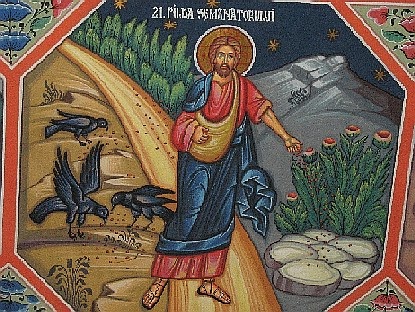
Dominica in Sexagesima: "Semen est verbum Dei. The seed is the word of God."

"And they by the way side are they that hear; then the devil cometh, and taketh the word out of their heart, lest believing they should be saved.
Now they upon the rock, are they who when they hear, receive the word with joy: and these have no roots; for they believe for a while, and in time of temptation, they fall away.
And that which fell among thorns, are they who have heard, and going their way, are choked with the cares and riches and pleasures of this life, and yield no fruit.
But that on the good ground, are they who in a good and perfect heart, hearing the word, keep it, and bring forth fruit in patience." (Luke 8, 4-15)

To welcome the seed of the Word is to welcome the Kingdom.

"This Kingdom shines out before men in the word, in the works and in the presence of Christ." To welcome Jesus' word is to welcome "the Kingdom itself." The seed and beginning of the Kingdom are the "little flock" of those whom Jesus came to gather around him, the flock whose shepherd he is. They form Jesus' true family. To those whom he thus gathered around him, he taught a new "way of acting" and a prayer of their own." (CCC 764)

Indeed, to welcome the Word is to welcome Jesus Christ Who is the Kingdom present among us.
 

Thursday, February 20, 2014

Septuagesima: "Run so as to obtain the prize."


"Fratres, Nescitis quod ii qui in stadio currunt, omnes quidem currunt, sed unus accipit bravium? Sic currite, ut comprehendatis." (1 Cor 9, 24-27; 10, 1-5)

"Know you not that they that run in the race, all run indeed, but one receiveth the prize? So run that you may obtain."

Self-mastery is the work of Lent for which we prepare on Septuagesima.
  
"And every one that striveth for the mastery, refraineth himself from all things: and they indeed that they may receive a corruptible crown; but we an incorruptible one.
"I therefore so run, not as at an uncertainty: I so fight, not as one beating the air:
"But I chastise my body, and bring it into subjection: lest perhaps, when I have preached to others, I myself should become a castaway."

"Self-mastery is a long and exacting work. One can never consider it acquired once and for all. It presupposes renewed effort at all stages of life. The effort required can be more intense in certain periods, such as when the personality is being formed during childhood and adolescence." (CCC 2342)

The prize won by running the race through self-mastery which brings holiness of life here on earth is eternal life on high in Christ Jesus our Lord. 

Friday, February 14, 2014

Saint Valentine, priest and martyr: “Ephphatha!”, “Be opened!” to God's love in Jesus Christ

God has sent us an invitation to love Him in Jesus Christ who expels evil. "Be opened" is His invitation to love God through a heart opened to God's grace through forgiveness of sins.

Priests participate in God's invitation to love Him in Christ as those who celebrate the sacraments for God's people. When he baptizes a priest uses these words of Christ, "Ephphatha!", be opened as a blessing of exorcism, opening the soul and body to God's grace by expelling sin.

Through faith and baptism we open our bodies and souls to the love of God in Jesus Christ, in particular as we receive Him in the Holy Eucharist.