It is popularly said that Christianity, like Islam and Judaism, is a religion “ of the Book.” Our Holy Father and the bishops who were gathered with him in Rome proposed that such a description of our faith does not capture the full reality of the encounter with Christ by grace. They teach us, rather, that ours is a “ religion of the word.” Such a term helps to better proclaim the truth that we enjoy a real encounter with the living presence of Christ made possible by the living Holy Spirit when the word of Scripture is proclaimed in the sacred liturgy.
Our Holy Father Benedict and the bishops at the October Synod on the Word of God in the Life and Mission of the Church have prepared well to lead the Church, the People of the Living Word of Christ, to go forward in hope in these days of change for our country following the presidential elections. The results of the elections on national and local levels — not known at this writing — will indicate whether our country will be a more hostile or a welcoming environment for the most vulnerable human beings among us.
As the fortunes of the cause for life swing like a pendulum through the vicissitudes of time, we must always build our lives of faith upon the one foundation that cannot fail which is the word of God. Christ, the Word of the Father, has sent His Spirit upon His Church that we may truly be a people of life, the life of grace which leads to the Kingdom and everlasting life.
The theme of Benedict XVI’s homily at the close of the synod urged us to be aware that “ Our Thinking Must Conform to God’s Thinking.” Our hearts must be transformed by His grace to be hearts of love, but the word is also proclaimed that our minds may conform to the truth. In Christ, through His word, the fullness of our humanity is called to encounter Him. And, as Benedict taught, “ Emphasis is put on the totality of this dedication to God, listing the three faculties that define man in his deep psychological structures: heart, soul, and mind.” The two greatest Commandments make this clear.
Benedict called us to attend to the catechetical element of our faith, perhaps best accomplished by allowing the Catechism of the Catholic Church to shed light upon the words of Scripture so that we comprehend in practical, livable ways what it means to live as those who love God. In his homily, Benedict recalled the passage in Matthew where Jesus tells His questioner that the first and greatest Commandment is to love God above all.
“ Then, however, Jesus adds something which, in truth, had not been asked by the doctor of law: ‘ The second resembles it: “You must love your neighbor as yourself”’( 22: 39). The surprising aspect of Jesus’ answer consists in the fact that He establishes a similarity between the first and the second Commandments, defined this time with a biblical formula drawn from the Levitic code of holiness ( cf. Lev. 19: 18) as well. And therefore, the two Commandments are associated in the role of main axis upon which all of biblical Revelation rests: ‘ On these two Commandments hang the whole law, and the prophets too’ ( 22: 40).”
What remains is for us to learn what it means for our words and actions to reflect love of God and neighbor as we are commanded. Benedict in his homily reminds us that the Book of Exodus, chapter 22, calls us to love “ the stranger, the orphan, the widow, and the indigent, that is to say those citizens that are without a ‘defender’.”
Those most without a “defender” in our midst are the little ones still developing in the womb. The unborn therefore call us to a concomitant responsibility to be their defenders. Whether the newly elected leaders in these coming years are open to the will of God in this regard or not, our work remains. We are compelled by love to conform our minds and hearts not to “ this present age” but to be evangelical witnesses, committed to the “ renewal of our minds” through faithfulness to the word of God in Christ, present in the word proclaimed in the liturgy as He speaks to us through the indwelling Spirit and truly abiding among us in the Eucharist.
In his homily at the closing of the synod, the Holy Father stressed that “ the lesson that we can draw from the experience of the Thessalonians, and experience that is a common factor in every authentic Christian community, is that love for the neighbor is born from the docile listening to the Divine Word and accepts also hardships for the truth of the Divine Word and thus true love grows and truth shines. It is so important to listen to the word and incarnate it in personal and community existence!”
There is no lack of hardship for those dedicated to the cause of Life! There have been many disappointments, perils, and sacrifices on the part of the defenders of life, especially since a majority among nine individuals sitting on a bench in this nation’s capital took it upon themselves in 1973 to declare legal this abominable crime that cries out to Heaven for vengeance. There will be many hardships ahead as well.
In the days and years ahead, the pro-life movement will be most effective as it is faithfully nourished in this most effective and powerful way, by the Word of Life Himself, living and active in His Church through word and sacrament, that He might take flesh anew in every believer. Be apostles of life by dedication to a correct and beautiful celebration of the Liturgy, attentively listening to the scriptural word and devotedly receiving the Eucharistic Word in adoration and love.
(Fr. Cusick's column, A Leaven In The World, appears weekly in The Wanderer Catholic Newspaper. The above is from the 6 November 2008 edition.)
Wednesday, November 5, 2008


Election: "he who walks in the way that is blameless shall minister to me"
1 I will sing of loyalty and of justice; to thee, O LORD, I will sing.
2 I will give heed to the way that is blameless. Oh when wilt thou come to me? I will walk with integrity of heart within my house;
3 I will not set before my eyes anything that is base. I hate the work of those who fall away; it shall not cleave to me.
4 Perverseness of heart shall be far from me; I will know nothing of evil.
5 Him who slanders his neighbor secretly I will destroy. The man of haughty looks and arrogant heart I will not endure.
6 I will look with favor on the faithful in the land, that they may dwell with me; he who walks in the way that is blameless shall minister to me.
7 No man who practices deceit shall dwell in my house; no man who utters lies shall continue in my presence. 8 Morning by morning I will destroy all the wicked in the land, cutting off all the evildoers from the city of the LORD.
-- Psalm 101
2 I will give heed to the way that is blameless. Oh when wilt thou come to me? I will walk with integrity of heart within my house;
3 I will not set before my eyes anything that is base. I hate the work of those who fall away; it shall not cleave to me.
4 Perverseness of heart shall be far from me; I will know nothing of evil.
5 Him who slanders his neighbor secretly I will destroy. The man of haughty looks and arrogant heart I will not endure.
6 I will look with favor on the faithful in the land, that they may dwell with me; he who walks in the way that is blameless shall minister to me.
7 No man who practices deceit shall dwell in my house; no man who utters lies shall continue in my presence. 8 Morning by morning I will destroy all the wicked in the land, cutting off all the evildoers from the city of the LORD.
-- Psalm 101
Tuesday, November 4, 2008
"Coming home" to oneself by going far away
First morning and enjoying "old" things in a "new" setting: a 45-minute run, hot caffe-latte with the help of a new neighbor and her stove, and exploring my new surroundings.

Our Lady watches prayerfully over the neighborhood, with the silhouette of Vesuvius scarcelty discernible in the distance to the west.

Jetties protect the beach and the fishing and sailing vessels.

The chapel of San Sosio presents an old and weatherworn, but proud, face.

We take time away from home and family, we think, to get away. But the joy we seek is found truly in "coming home" to ourselves. This we can do anywhere. The gifts our Lord has always given, whether we have been ready to receive them or not, stand out in starker relief when we have removed ourselves from the familiar and are challenged by new places and circumstances to move forward in faith and trust. It is the Lord who is at work in this self-discovery, it is He who truly reveals that which we are able to love in ourselves: His own goodness in grace.
“Let hearts rejoice who search the Lord. Seek the Lord and his strength, seek always the face of the Lord.” (Psalm 105:3-4)
(Photos by author: Chapel of San Sosio in Miseno (Bacoli), Italia, views of gulf of Napoli.)

Our Lady watches prayerfully over the neighborhood, with the silhouette of Vesuvius scarcelty discernible in the distance to the west.

Jetties protect the beach and the fishing and sailing vessels.

The chapel of San Sosio presents an old and weatherworn, but proud, face.

We take time away from home and family, we think, to get away. But the joy we seek is found truly in "coming home" to ourselves. This we can do anywhere. The gifts our Lord has always given, whether we have been ready to receive them or not, stand out in starker relief when we have removed ourselves from the familiar and are challenged by new places and circumstances to move forward in faith and trust. It is the Lord who is at work in this self-discovery, it is He who truly reveals that which we are able to love in ourselves: His own goodness in grace.
“Let hearts rejoice who search the Lord. Seek the Lord and his strength, seek always the face of the Lord.” (Psalm 105:3-4)
(Photos by author: Chapel of San Sosio in Miseno (Bacoli), Italia, views of gulf of Napoli.)
Treno a Napoli - Train to Naples
You know you have arrived when you see this world-famous topography looming over the teeming and most densely populated city in Europe from the train window:

Despite vicious rumors to the contrary, there are functioning trash trucks in Naples.

Welcome to my place of worship for the next week, the chapel of San Sosio in Miseno, dedicated to one of the deacons martyred with the great patron of Naples, San Gennaro. The "casa canonica" or rectory-apartment upstairs, will be my home during my stay. Fr. Domenico, the pastor, has invited me to celebrate holy Mass here some days this week.

The holy patron, San Sosio.

Despite the disappointments of the past, in faith and trust we turn again and again to the "images" of Christ in the members of His Body in order to truly know and love Him and discover His love for us. Here catechist Enza prepares her class for the celebration of the Sunday liturgy through a lesson on the encounter of the Lord with the Samaritan woman. By taking part in the catechism class, the visitor receives a gift from the Lord, His love, that is possible only by giving oneself as He does in the word of the Scriptures and His Body in the Eucharist. "What you have received as a gift, give as a gift."

New friends reach out with curiosity, inquiring about my home far away and discover my life in many ways is very much like theirs.

Rewarded at day's end with a home-made meal with old friends.

Enzo and Teresa.


Father and son, Donato.

Pasta with lentils, a fresh salad of tomatoes with tuna and olives, fresh bread, salami and steak.
The food was swept quickly from the plate. The cook has a passion for his craft and the guest is most pleased to taste the fare. Grazie amici!

Despite vicious rumors to the contrary, there are functioning trash trucks in Naples.

Welcome to my place of worship for the next week, the chapel of San Sosio in Miseno, dedicated to one of the deacons martyred with the great patron of Naples, San Gennaro. The "casa canonica" or rectory-apartment upstairs, will be my home during my stay. Fr. Domenico, the pastor, has invited me to celebrate holy Mass here some days this week.

The holy patron, San Sosio.

Despite the disappointments of the past, in faith and trust we turn again and again to the "images" of Christ in the members of His Body in order to truly know and love Him and discover His love for us. Here catechist Enza prepares her class for the celebration of the Sunday liturgy through a lesson on the encounter of the Lord with the Samaritan woman. By taking part in the catechism class, the visitor receives a gift from the Lord, His love, that is possible only by giving oneself as He does in the word of the Scriptures and His Body in the Eucharist. "What you have received as a gift, give as a gift."

New friends reach out with curiosity, inquiring about my home far away and discover my life in many ways is very much like theirs.

Rewarded at day's end with a home-made meal with old friends.

Enzo and Teresa.


Father and son, Donato.

Pasta with lentils, a fresh salad of tomatoes with tuna and olives, fresh bread, salami and steak.
The food was swept quickly from the plate. The cook has a passion for his craft and the guest is most pleased to taste the fare. Grazie amici!
"Imposing our virtue"? No! choose life! Vote for Life!
In a prayer for the election by Sr. Joan Chittister, OSB, there is an ever so barely detectable swipe at those who are faithful to the pro-life mission and teaching of the Lord in His Church:
"Give us leaders
who lead this nation to virtue
without seeking to impose our kind of virtue
on the virtue of others."
We are forbidden to worship the "god" of false irenicism, a false peace, in which we grant ourselves the luxury of looking the other way while the unborn are slaughtered as long as money is flowing into our wallets or food into our mouths.
Love of human life IS a virtue, a strength.
Love of life commanded by God IS a virtue, a strength.
Urging, teaching, exhorting others to the virtue of loving and respecting all life, born and unborn, is not an "imposition" but, rather, a privilege, a grace and a commandment of the living and true God: "Love your neighbor as yourself."
Thank you, Sr. Joan, for offering your opinion, but it is found lacking.
Life IS the issue. Do not leave the cross of Christ at the voting booth door!
CHOOSE LIFE!
"Give us leaders
who lead this nation to virtue
without seeking to impose our kind of virtue
on the virtue of others."
We are forbidden to worship the "god" of false irenicism, a false peace, in which we grant ourselves the luxury of looking the other way while the unborn are slaughtered as long as money is flowing into our wallets or food into our mouths.
Love of human life IS a virtue, a strength.
Love of life commanded by God IS a virtue, a strength.
Urging, teaching, exhorting others to the virtue of loving and respecting all life, born and unborn, is not an "imposition" but, rather, a privilege, a grace and a commandment of the living and true God: "Love your neighbor as yourself."
Thank you, Sr. Joan, for offering your opinion, but it is found lacking.
Life IS the issue. Do not leave the cross of Christ at the voting booth door!
CHOOSE LIFE!
Monday, November 3, 2008
Christ in Afghanistan

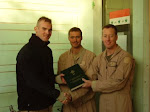
A friend, LT Peter Fisher, USMC, (r), sends this photo from Afghanistan of himself together with chaplain-colleague Father Joe Porpiglia, USN, of the Diocese of Buffalo taken after the celebration of holy Mass on 2 November. Semper Fidelis!
Subscribe to:
Posts (Atom)