Thursday, March 28, 2024

Holy Thursday: To Suffer at the Hands of the Wicked

“Deliver me, O my God, out of the hand of the sinner, * and out of the hand of the transgressor of the law and of the unjust.
For thou art my patience, O Lord: * my hope, O Lord, from my youth.” Psalm 70


Lesson from the book of Lamentations

Lam 1:1-5
1 Aleph. How doth the city sit solitary that was full of people! how is the mistress of the Gentiles become as a widow: the princes of provinces made tributary!
2 Beth. Weeping she hath wept in the night, and her tears are on her cheeks: there is none to comfort her among all them that were dear to her: all her friends have despised her, and are become her enemies.
3 Ghimel. Juda hath removed her dwelling place because of her affliction, and the greatness of her bondage: she hath dwelt among the nations, and she hath found no rest: all her persecutors have taken her in the midst of straits.
4 Daleth. The ways of Sion mourn, because there are none that come to the solemn feast: all her gates are broken down: her priests sigh: her virgins are in affliction, and she is oppressed with bitterness.
5 He. Her adversaries are become her lords, her enemies are enriched: because the Lord hath spoken against her for the multitude of her iniquities: her children are led into captivity: before the face of the oppressor.

From the Treatise of St. Augustine, Bishop (of Hippo) Upon the Psalms

On Psalm liv, 1
Give ear to my prayer, O God, and despise not my supplication: attend unto me and hear me. These are the words of a man travailing, anxious, and troubled. He prayeth in the midst of much suffering, longing to be rid of his affliction. Our part is to see what that his affliction was, and when he hath told us, to acknowledge that we also suffer therefrom; that so, partaking in his trouble, we may take part also in his exercise, and am troubled. Wherein mourned he? Wherein was he troubled? He saith: In my exercise. In the next words he giveth us to know that his affliction was the oppression of the wicked, because of the voice of the enemy, and because of the oppression of the wicked, and this suffering which came upon him at the hands of wicked men, he hath called his exercise. Think not that wicked men are in this world for nothing, or that God doth no good with them. Every wicked man liveth, either to repent, or to exercise the righteous.


O God, from Whom Judas received the punishment of his guilt, and the thief the reward of his confession: grant unto us the full fruit of Thy clemency; that even as in His Passion our Lord Jesus Christ gave to each retribution according to his merits, so having cleared away our former guilt, He may bestow on us the grace of His Resurrection.

Wednesday, March 27, 2024

St John Chrysostom: Homily for Spy Wednesday


The Kiss of Judas, Giotto 

Holy Wednesday, historically referred to in the West as Spy Wednesday (“spy” meaning to ambush or ensnare), is the time where the Universal Church recalls Judas’s intention to betray his master, Our Lord Jesus Christ. 

Liturgical Background

At the traditional Latin Mass, the Gospel of Luke 22:39-71 & 23:1-53 is appointed to be read. That account of Our Lord’s Passion includes Judas’s betrayal at Gethsemane. In the Byzantine Rite, Judas’s betrayal is also recounted, this time with the reading of the Gospel of Matthew 26:6-16 at the evening Presanctified Liturgy of Pope St. Gregory the Great.

The following text are excerpts from St. John Chrysostom’s 80th Homily on Matthew.

St. John’s Homily

Then went one of the twelve, he that was called Judas Iscariot, unto the chief priests, and said unto them, What will you give me, and I will deliver Him unto you? 

Then. When? When these things were spoken, when He had said, it is for my burial, and not even thereby was he moved to compunction, neither when he heard that the Gospel should be preached everywhere did he fear (and yet it was the language of unspeakable power), but when women showed so much honor, and women that had been harlots, then he wrought the devil's works.

So great an evil is covetousness, this made him both a traitor, and a sacrilegious robber. Hearken, all you covetous, you that have the disease of Judas; hearken, and beware of the calamity. For if he that was with Christ, and wrought signs, and had the benefit of so much instruction, because he was not freed from the disease, was sunk into such a gulf; how much more shall you, who do not so much as listen to the Scripture, who are constantly riveted to the things present, become an easy prey to this calamity, unless you have the advantage of constant care. 

Every day was that man with Him, who had not where to lay His head, and every day was he instructed by deeds, and by words, not to have gold, nor silver, nor two coats; and yet he was not taught self-restraint; and how do you expect to escape the disease, if you have not the benefit of earnest attention, and dost not use much diligence? For terrible, terrible is the monster, yet nevertheless, if you be willing, you will easily get the better of him. For the desire is not natural; and this is manifest from them that are free from it. For natural things are common to all; but this desire has its origin from remissness alone; hence it takes its birth, hence it derives its increase, and when it has seized upon those who look greedily after it, it makes them live contrary to nature. For when they regard not their fellow countrymen, their friends, their brethren, in a word all men, and with these even themselves, this is to live against nature. 

Whence it is evident that the vice and disease of covetousness, wherein Judas, being entangled, became a traitor, is contrary to nature. And how did he become such a one, you may say, having been called by Christ? Because God's call is not compulsory, neither does it force the will of them who are not minded to choose virtue, but admonishes indeed, and advises, and does and manages all things, so as to persuade men to become good; but if some endure not, it does not compel. But if you would learn from what cause he became such as he was, you will find him to have been ruined by covetousness.

And how was he taken by this calamity? One may say. Because he grew remiss. For hence arise such changes, as on the other hand, those for the better from diligence. How many for instance that were violent, are now more gentle than lambs? How many lascivious persons have become afterwards continent? How many, heretofore covetous, yet now have cast away even their own possessions? And the contrary again has been the result of remissness…

And all these things have I said, to show that if we be vigilant, no one shall harm us; and that the harm arises not from poverty but from ourselves. Wherefore I beseech you with all diligence to put away the pest of covetousness, that we may both be wealthy here, and enjoy the good things eternal, unto which God grant we may all attain, by the grace and love towards man of our Lord Jesus Christ, to whom be glory world without end. Amen.

Sunday, February 11, 2024

Dominica in Quinquagesima


Epistle 

(1 Corinthians 13:1-13) 

The merit of our good works, like the light which enlightens our minds, will be in proportion to the charity which we possess. Let us therefore, dispose our will to detachment from everything in it that is opposed to divine charity, so that having seen God "through a glass in a dark manner," by faith, here on earth, we may behold Him "face to face" in Heaven, in all the fullness of our love for Him.


Gospel 

(Luke 18:31-43) 

"The man blind from birth of whom the Gospel speaks", says St. Gregory in the Matins of today, "is most certainly the human race. Since its expulsion from Paradise in the person of our first parents, it has known nothing of the inspirations of supernatural light, and has moreover suffered from being plunged into darkness through its condemnation." It is Jesus Christ Who, by the merits of His Passion, must open its eyes as He did for the blind man of Jericho and at the same time, free it from the captivity of error and sin.

(St. Andrew Missal)

Wednesday, February 7, 2024

The controversial relics of San Romualdo

Ecco Le Marche

Our loyal readers will immediately recognize the name San Romualdo! How often did we mention this saint in our articles? The Saint was born between 951-953 in Ravenna, not exactly near Le Marche, especially at that time!

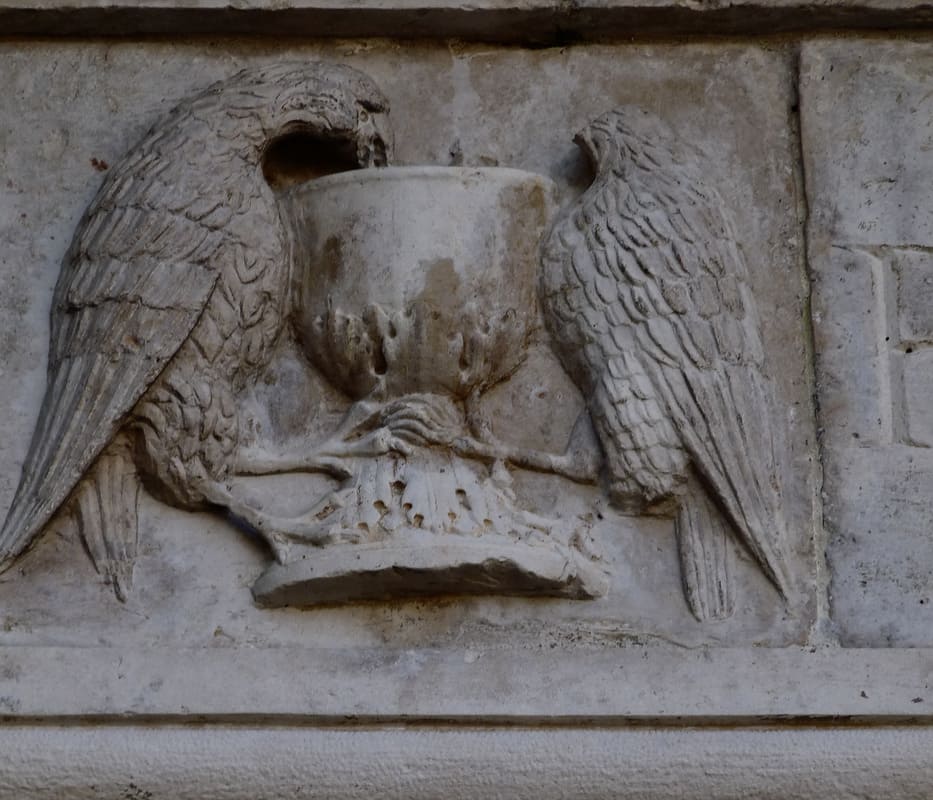
Around the age of 20 he converted to the Benedictine order, stayed in Spain, came back to Ravenna, and then eventually, around the Year 1000, ended up in Camaldoli, near Arezzo. There, he founded a branch of the Benedictines: the Camaldolese Order, to which he also added Eastern hermitage in addition to the Western Ora et Labora (pray and work). This union of Western and Eastern philosophy was reflected in the symbol of this Order: two doves drinking together from the same chalice.

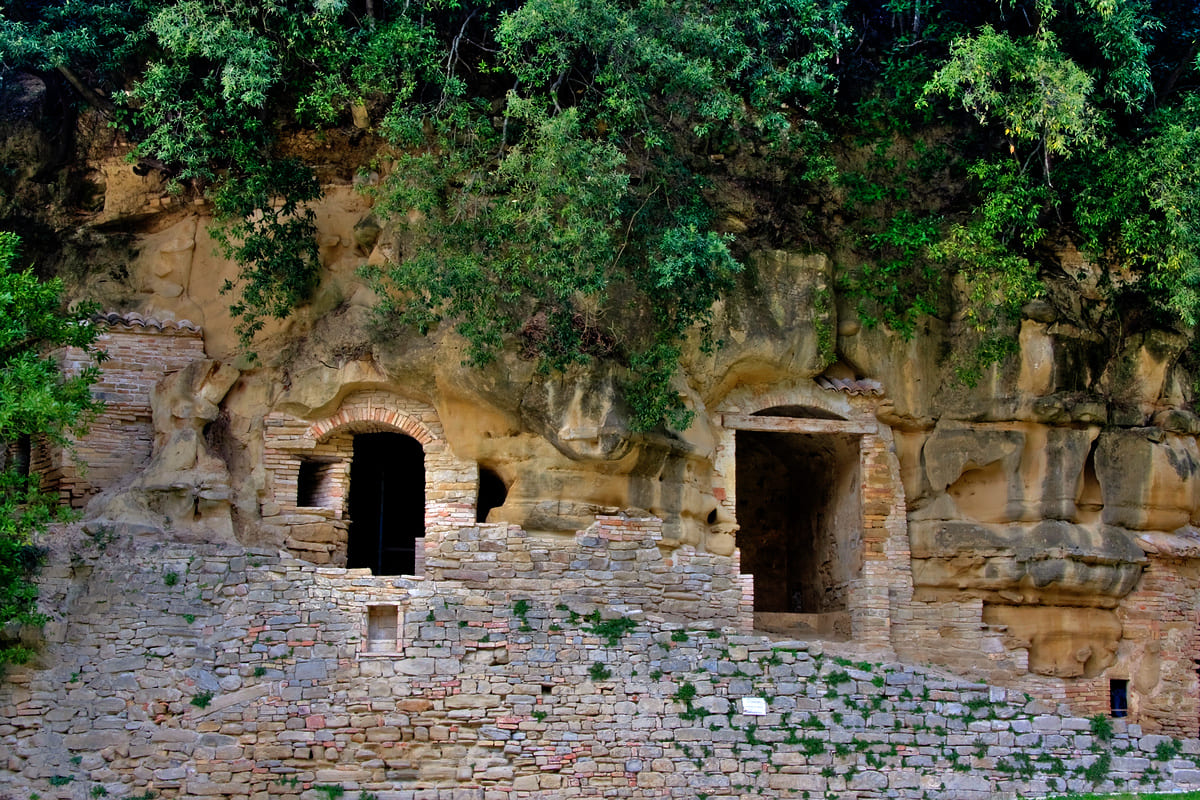
The Camaldolese monks therefore often built hermit caves, or hermit buildings, in addition to ordinary monasteries. For example, the Eremo dei Frati Bianchi in Cupramontana, where the first monks lived in cliff dwellings.

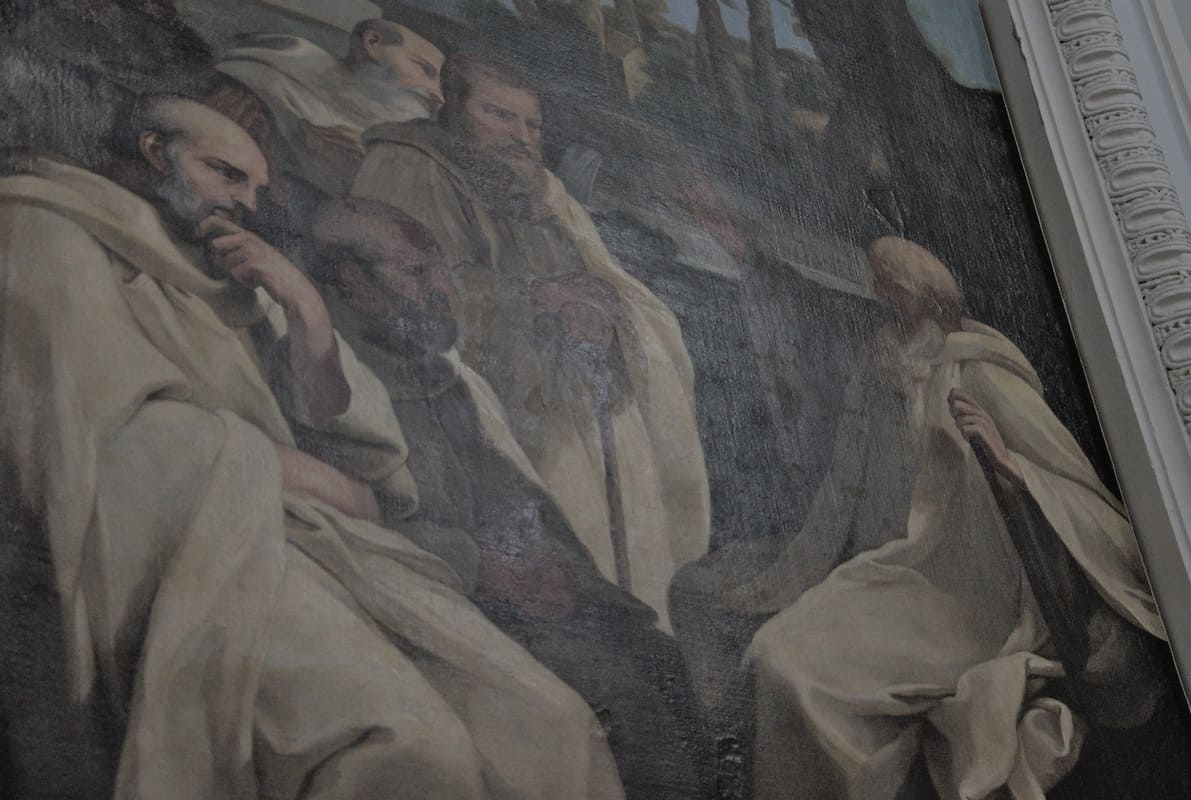
An 18th century copy of the painting The Apparition by Andrea Sacchi (17th century in the Vatican Museums) hangs in the San Leonardo Church in Cupramontana. Here San Romualdo is depicted as an elderly man in his white habit.

Romualdo then moved regularly in Umbria and Le Marche, where he died in 1027 in the abbey of Valdicastro.

In addition, a small community took the name of this saint: Poggio San Romualdo

He was canonized in 1595. But already in 1480 his body was already important. Two monks from Ravenna tried to smuggle Romualdo’s body from the Abbey of Valdicastro back to his hometown. But during their stop in Jesi, their plan was discovered. From then on, a whole battle started between Fabriano (to which Valdicastro belonged) and Jesi, because relics or better still bodies of clerics who were venerated, always attracted many pilgrims and of course meant income!

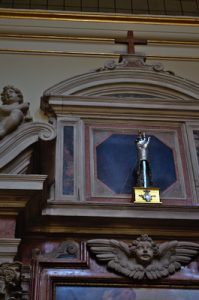
In the end, Fabriano received almost all of the body, with Jesi receiving part of the arm that can be seen in the Cathedral of Jesi.


This is how Romualdo ended up in the San Biagio church of Fabriano (13th-18th century), which was then called the Chiesa dei Santi Biagio e Romualdo

Source: https://eccolemarche.eu/en/blog/2023/02/04/the-controversial-relics-of-saint-romualdo/

Friday, February 2, 2024

Candlemas

 And suddenly there will come to the temple the Lord ...


... whom you seek."
-- Mal 3:1-4

"My eyes have seen..Salvation!"
-- Luke 2:22ff

From the Holy Gospel according to Luke
Luke 2:22-32
In that time, after the days of her purification according to the law of Moses were accomplished, they carried him to Jerusalem to present him to the Lord, as it is written in the law of the Lord. And so on.

Homily on this passage by St. Ambrose, Bishop of Milan.
Bk. 2, Comm. on Luke II
And, behold, there was a man in Jerusalem, whose name was Simeon, and the same man was just and devout, waiting for the consolation of Israel. The birth of the Lord is attested not only by Angels and Prophets, and shepherds, but also by elders and just men. Every age, and both sexes, as well as the miracles of the events themselves, are here to strengthen our faith. A virgin conceiveth, a barren woman beareth, a dumb man speaketh, Elizabeth prophesieth, the wise man worshippeth, the unborn child leapeth, the widow praiseth, and the just man waiteth.
Well is he called just, who looked not for favour for himself, but for consolation for his people. He desired to be set free from the bondage of this frail body, but he waited to see the Promised One for he knew that blessed are the eyes that see Him. Then took he Him up in his arms, and blessed God, and said: Lord, now lettest Thou thy servant depart in peace, according to thy word. Behold a just man, confined in the weary prison of the body, desiring to be dissolved and to begin to be with Christ. For to be dissolved and to be with Christ is much better. Phil. i. 23.


Whosoever will be dissolved and be with Christ, let him come into the Temple, let him come to Jerusalem, let him wait for the Lord's Christ, let him take hold on the Word of God, let him embrace it with good works, as it were with arms of faith and then let him depart in peace, for he shall not see death, who hath seen life. Behold how the Lord's Birth doth overflow with abounding grace for all, and prophecy is not denied to the just, but to the unbelieving. Behold, Simeon prophesieth that the Lord Jesus Christ is come for the fall and rising again of many; yea, He shall separate the just from the unjust by their deserts, and according as our work shall be, so shall the true and righteous Judge command us to be punished or rewarded.

N.B. Today we hold the blessed tapers alight in the holy liturgy of procession and Mass. As the lights and decorations of Christmas are put away for next year’s celebration of the Incarnation, we seek, behold and adore all the more intensely through faith the light of Christ truly present in our temples as the Holy Eucharist. And when we receive Him thus in a state of grace we become alight through the Truth we believe, embrace and live as Divine light amidst the darkness and sin of this passing world.

Thursday, January 18, 2024

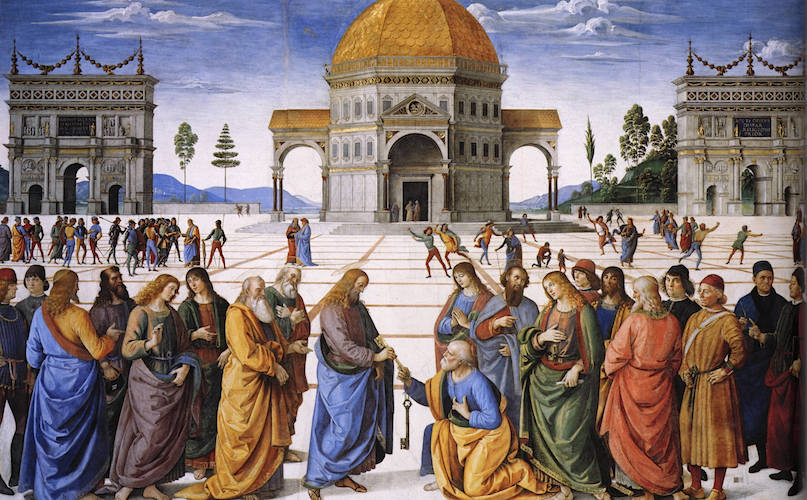
Cathedræ S. Petri and the “Keys of Peter”: To forgive sin, not to bless it

Perugino, Christ Giving the Keys of the Kingdom to St. Peter, Sistine Chapel, 1481-83, fresco, 10 feet 10 inches x 18 feet (Vatican, Rome) 

From the Holy Gospel according to Matthew
Matt 16:13-19
At that time, Jesus came into the quarters of Cesarea Philippi: and he asked his disciples, saying: Whom do men say that the Son of man is? And so on.

Homily by St. Hilary, Bishop of Poitiers.
Commentary on Matthew xvi.
The Lord asketh His disciples who men say that He is, and He addeth, He, the Son of Man. Let us ever remember to hold fast this truth of our profession, namely, that the Son of God is the Son of Man also. Were He one and not the other, then were He no Saviour for us. The Lord then, having heard the various opinions of men, asketh, But Who say ye that I am? And Simon Peter answered and said Thou art the Christ, the Son of the living God. Peter had weighed the questions. The Lord had asked, Who do men say that I, the Son of Man, am? 

From the Holy Gospel according to Matthew

Matt 16:13-19
At that time, Jesus came into the quarters of Cesarea Philippi: and he asked his disciples, saying: Whom do men say that the Son of man is? And so on.

Homily by St. Hilary, Bishop of Poitiers.
Commentary on Matthew xvi.
The Lord asketh His disciples who men say that He is, and He addeth, He, the Son of Man. Let us ever remember to hold fast this truth of our profession, namely, that the Son of God is the Son of Man also. Were He one and not the other, then were He no Saviour for us. The Lord then, having heard the various opinions of men, asketh, But Who say ye that I am? And Simon Peter answered and said Thou art the Christ, the Son of the living God. Peter had weighed the questions. The Lord had asked, Who do men say that I, the Son of Man, am? That He was Son of Man was sufficiently evident to all who looked upon His Body. But when He spake of His whole Self, and asked, Who do ye say that I am? He showed that the mind had something to grasp beyond That Which was seen, for Son of Man He was manifestly. What judgment did He wish them to give? I think it was not /that which He had owned concerning Himself. That something more, which He wished them to own, was a hidden thing, whereunto the faith of them that believed in Him was to reach.

Peter’s confession was followed by a proper reward for having seen the Son of God in the Son of Man. Blessed is this holy Apostle, in whose praise it is said that he saw with more than human eyes That Which was unseen, who gazed upon Flesh and Blood, and by the secret revelation of the Heavenly Father recognised the Eternal Son of God; who was the first thought worthy to acknowledge the Divinity of Christ. {Here, if necessary, the Lesson is divided.) God bless thee, O Peter, thou who by uttering for the first time the title of Divine honour, didst lay the goodly foundation of the Church! God bless thee, thou worthy rock whereon she is built, for ever triumphant over the infernal powers, the gates of hell, and the bands of death! God bless thee, happy door-keeper of heaven, to whose keeping are given the keys of the everlasting mansions, whose sentences on earth are already confirmed in heaven so that whatsoever thou shalt bind on earth shall be bound in heaven, and whatsoever thou shalt loose on earth shall be loosed in heaven. 

N.B. The forgiveness of sins is the blessing of Christ in the Church through the ministry of priests in union with Peter’s successor.

The blessing of sin is a betrayal. A lie from the Evil One.

Scripture wherein Peter speaks to us a word for our time.

1 Pet 1:3-9

Blessed be the God and Father of our Lord Jesus Christ, who according to his great mercy hath regenerated us unto a lively hope, by the resurrection of Jesus Christ from the dead,
4 Unto an inheritance incorruptible, and undefiled, and that can not fade, reserved in heaven for you,
5 Who, by the power of God, are kept by faith unto salvation, ready to be revealed in the last time.

Wherein you shall greatly rejoice, if now you must be for a little time made sorrowful in diverse temptations:
7 That the trial of your faith much more precious than gold which is tried by the fire may be found unto praise and glory and honour at the appearing of Jesus Christ:
8 Whom having not seen, you love: in whom also now, though you see him not, you believe: and believing shall rejoice with joy unspeakable and glorified;
9 Receiving the end of your faith, even the salvation of your souls.

℣. O Lord, hear my prayer.
℟. And let my cry come unto thee.
Let us pray.
O God, Who hast given unto thy Blessed Apostle Peter the keys of the kingdom of heaven, and the power to bind and to loose, loose us, we beseech thee, at his mighty intercession, from all the bands of our sins.
Who livest and reignest with God the Father in the unity of the Holy Spirit, God, world without end.
℟. Amen

Sunday, January 7, 2024

Sanctæ Familiæ Jesu Mariæ Joseph


12 Put ye on therefore, as the elect of God, holy, and beloved, the bowels of mercy, benignity, humility, modesty, patience:
13 Bearing with one another, and forgiving one another, if any have a complaint against another: even as the Lord hath forgiven you, so do you also.
14 But above all these things have charity, which is the bond of perfection:
15 And let the peace of Christ rejoice in your hearts, wherein also you are called in one body: and be ye thankful.
16 Let the word of Christ dwell in you abundantly, in all wisdom: teaching and admonishing one another in psalms, hymns, and spiritual canticles, singing in grace in your hearts to God.

17 All whatsoever you do in word or in work, do all in the name of the Lord Jesus Christ, giving thanks to God and the Father by him.
18 Wives, be subject to your husbands, as it behoveth in the Lord.
19 Husbands, love your wives, and be not bitter towards them.
20 Children, obey your parents in all things: for this is well pleasing to the Lord.
21 Fathers, provoke not your children to indignation, lest they be discouraged.


Lesson from the letter of St. Paul the Apostle to the Colossians
Col 3:12-21

From the Apostolic Letters of Pope Leo XIII
Breve « Neminem fugit » 14 junii 1892
When God in his mercy determined to accomplish the work of man's renewal, which same had so many long ages awaited, he appointed and ordained this work on such wise that its very beginning might shew to the world the august spectacle of a Family which was known to be divinely constituted; that therein all men might behold a perfect model, as well of domestic life as of every virtue and pattern of holiness: for such indeed was the Holy Family of Nazareth. There in secret dwelt the Sun of Righteousness, until the time when he should shine out in full splendour in the sight of all nations. There Christ, our God and Saviour, lived with his Virgin Mother, and with that most holy man Joseph, who held to him the place of father. No one can doubt that in this Holy Family was displayed every virtue which can be called forth by an ordinary home life, with its mutual services of charity, its holy intercourse, and its practices of godly piety, since the Holy Family was destined to be a pattern to all others. For that very reason was it established by the merciful designs of Providence, namely, that every Christian, in every walk of life and in every place, might easily, if he would but give heed to it, have before him a motive and a pattern for the good life.

From the Holy Gospel according to Luke
Luke 2:42-52
And when he was twelve years old, they going up into Jerusalem, according to the custom of the feast, And having fulfilled the days, when they returned, the child Jesus remained in Jerusalem; and his parents knew it not...
And he went down with them and came to Nazareth, and was obedient to them; and his mother kept all these things in her heart. And Jesus increased in wisdom and in stature, and in favor with God and manAnd so on.

Homily by Saint Bernard

Learn, O man, to obey! Learn, O earth, to be subject! Learn, O dust, to submit! The Evangelist speaking of thy Creator saith: And he was subject unto them. And there is no doubt that this sheweth us that God was subject to Mary and Joseph. Shame on you, ye proud entities of dust and ashes! God abaseth himself, and dost thou, O creature sprung from the earth, exalt thyself? God maketh himself subject to man, and dost thou, who art always so eager to lord it over men, set up thyself to lord it over thy Creator? For as often soever as I desire pre-eminency over men, so often do I strive to excel God. For of him it was said: And he was subject unto them. If thou disdainest, O man, to follow the example of man, at least thou canst follow thy Creator without dishonour. If thou canst not, perchance, follow him whithersoever he goeth, deign at least to follow him in this thing wherein he hath emptied himself, and made himself of no reputation, for the sake of such as thou.