Tuesday, October 7, 2008

"Money disappears...is nothing." The Word shall never pass away.


Pope: Money Crisis Shows Importance of Bible

Says Economy and Material Things Will Pass Away

VATICAN CITY, OCT. 6, 2008 (Zenit.org).- The current economic crisis shows the importance of building our lives on the firm foundation of the Word, Benedict XVI affirmed on the first day of the synod of bishops.

The Pope said this today as he offered a meditation to the 244 synod fathers gathered for the first full day of the assembly on the word of God in the life and mission of the Church.

"We see it now in the fall of the great banks," the Holy Father said. "This money disappears; it is nothing -- and in the same way, all these things, which lack a true reality to depend on, and are elements of a second order. The word of God is the basis of everything, it is the true reality. And to be realists, we should count on this reality."

"We should change our idea that matter, solid things, things we touch, are the most solid and secure reality," the Pontiff continued. He noted how Jesus spoke of the two possibilities of building a house on the sand or on a firm rock.

"He who builds only on things that are visible and tangible, on success, a career, money -- he is building on sand," he said. "Apparently these are the true realities, but one day they will pass away."

Built on sand

The Bishop of Rome continued: "And in this way, all these things that do not have a true reality to count on. […] He who builds his house on these realities, on material things, on success, on everything that seems to be, builds on sand.

"Only the Word of God is the foundation of all reality; it is stable like the heavens and more than the heavens. It is the reality. Therefore we should change our concept of realism. The realist is he who recognizes in the Word of God, in this reality apparently so fragile, the basis of everything."

Archbishop Claudio Celli, president of the Pontifical Council for Social Communications, afterward told the press that the Pope had invited his listeners to see economy and finances as a "penultimate reality."

"It is undeniable that other realities, when they are compared to the Word, reveal their limits," he explained. "They are truly penultimate, but not the final truth.

"The heart of the topic that the Pope addressed is not the current economic situation, but the importance of the Word of God in the path of man. And from this light, other dimensions are like clouds that show their flimsiness."

Monday, October 6, 2008

Love over legalism


"Which of these three, in your opinion, was neighbor to the robbers' victim?"

He answered, "The one who treated him with mercy."

Jesus said to him, "Go and do likewise."

Who today will become, through the grace of His love, your neighbor that, in law, has no more claim upon you than that of a stranger?

"Go and do likewise."

Scriptures for today
.

(Art: Jacopo Bassano, The Good Samaritan probably 1550-70, National Gallery, London.)

Sunday, October 5, 2008

Respect Life!


"My fellow bishops, writing ten years ago, explained why some evils – abortion and euthanasia in particular – take precedence over other forms of violence and abuse:

" 'The failure to protect life in its most vulnerable stages renders suspect any claims to the "rightness" of positions in other matters affecting the poorest and least powerful of the human community. If we understand the human person as "the temple of the Holy Spirit’"-- the living house of God -- then these latter issues fall logically into place as the crossbeams and walls of that house. All direct attacks on innocent human life, such as abortion and euthanasia, strike at the house’s foundation [emphasis in the original]. These directly and immediately violate the human person’s most fundamental right -- the right to life. Neglect of these issues is the equivalent of building our house on sand.' "

("Living the Gospel of Life: A Challenge to American Catholics,", 23, USCCB.).

-- From the Respect Life Sunday homily by His Excellency Bishop Martino, Scranton, Penna.

Read the entire text here.

Saturday, October 4, 2008

"Surely they will respect my son"

27th Sunday in Ordinary Time

The Father sends His Son into the vineyard, into our midst, in every Eucharistic Sacrifice. How do we receive Him? Will our young people believe us when we tell them "It is the Lord"...

- if we are not dressed in holy attire?

- if we have not fasted?

- if we arrive late and distracted to church?

- if we do not leave our cell phones at home or turn them off?

- if our prayer is not offered with love in the heart and attentive thought?

- if we receive the Eucharist in a state of serious sin?

Should they believe the words we speak? Or should they rather believe their eyes which see the Son is, in many places, not respected, loved and adored as is His due as our Lord and God?

Are we workers in the vineyard who accept the Son with love and reverence as coming from the Father? Restore the sacred!

Meeting Christ in the Liturgy offers a reflection for the Twenty-seventh Sunday in Ordinary Time.

(Art: The Parable of the Vineyard by Marten Van Valckenborch.)

Friday, October 3, 2008

Stop taking it personally


Someone did not return your smile? Someone did not receive you with kindness?

"He who hears you, hears me."

If you would but speak with the voice of Christ and welcome others as you would welcome Christ then it is He whose image you bear. It is your grace and privilege that He speaks to others and loves others through you.

And when they reject you, it is Christ they reject. When someone refuses to welcome you it is He whom they refuse when they turn away or ignore you.

So, stop taking it personally.

It is therefore not your burden to carry when the other rejects you or refuses to welcome you. It is a matter between the other person and the Lord; so mind your own business and leave the weight of others for Christ to carry.

"He who rejects you rejects me. He who rejects me rejects Him who sent me."

Scripture: Lk 10:13-16

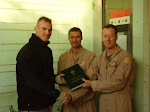
(Photo: Thanks to Iraq Pictures Blogspot.)

Thursday, October 2, 2008

When voting is cooperation in a moral evil


To vote for a pro-abortion candidate for elected office is prohibited for Catholic Christians by the law of God because it is a cooperation in a moral evil.

This is so when a vote cast for one candidate is a rejection of the pro-life alternative in a particular election.

God is the highest lawgiver, therefore God’s law is the highest law. God has decreed in the Ten Commandments, “Thou Shalt Not Kill.” Procured abortion, the direct intention to take the most innocent of human lives, that of the child in the womb, is a violation of this law of God, because it is intentional murder.

But the truth about the dignity of human life is not a purely “religious” issue. Although we know through divine Revelation that God prohibits murder, the truth about the defense of every human life is accessible to every human person through the use of reason alone.

A candidate for elected office does not get “off the hook” by saying: “I am personally opposed to abortion, but cannot impose my opinions upon others.” This is so for the reason that the dignity of human life is not based upon anyone’s opinion but upon a fact that is accessible to every reasoning human being: If any human life is good, then all human lives are good and worth defending, from the moment of conception.

In this campaign 2008, religion is being used as a scapegoat on the part of cowards to avoid taking personal responsibility for their decisions. To take cover under the mantle of religious faith by arguing for a diversity of views under the umbrella
of separation of Church and state is either ignorance or disingenuousness.

Archbishop Charles Chaput, OFM Cap., of Denver is taking great steps to eradicate ignorance and uncover disingenuousness with the publication of his best-selling tome, Render Unto Caesar (available at www.amazon.com, or check with your local bookseller). One of the first places to which Archbishop Chaput points his readers in their quest for a good guide to Catholic citizenship is the 1998 pastoral statement by the U.S. bishops, Living the Gospel of Life. The archbishop calls this document “the best tool anywhere for understanding the American Catholic political vocation.” He commends it for its “clarity, coherence, and force.”

For readers who wish to read the letter, it can be found at www.usccb.org/prolife/gospel.shtml. Perhaps quoting part of the document here will help to spark interest in a study of the document as a whole.

“6) In a special way, we call on U.S. Catholics, especially those in positions of leadership — whether cultural, economic, or political — to recover their identity as followers of Jesus Christ and to be leaders in the renewal of American respect for the sanctity of life. ‘Citizenship’ in the work of the Gospel is also a sure guarantee of responsible citizenship in American civic affairs. Every
Catholic, without exception, should remember that he or she is called by our Lord to proclaim. His message. Some proclaim it by word, some by action and all by example.

“But every believer shares responsibility for the Gospel. Every Catholic is a missionary of the Good News of human dignity redeemed through the cross. While our personal vocation may determine the form and style of our witness, Jesus calls each
of us to be a leaven in society, and we will be judged by our actions. No one, least of all someone who exercises leadership in society, can rightfully claim to share fully and practically the Catholic faith and yet act publicly in a way contrary
to that faith.

“7) Our attitude toward the sanctity of life in these closing years of the ‘American century’ will say volumes about our true character as a nation. It will also shape the discourse about the sanctity of human life in the next century, because what
happens here, in our nation, will have global consequences. It is primarily U.S. technology, U.S. microchips, U.S. fiber-optics, U.S. satellites, U.S. habits of thought and entertainment, which are building the neural network of the new global mentality.

“What America has indelibly imprinted on the emerging global culture is its spirit. And the ambiguity of that spirit is why the Pope appealed so passionately to the American people in 1995. ‘It is vital for the human family,’ he said, ‘that in continuing to seek advancement in many different fields — science, business, education, and art, and wherever else your creativity leads you — America keeps compassion, generosity, and concern for others at the very heart of its efforts.’ That will be no easy task.”

The task begins this fall with every vote cast for human life in all its stages and conditions, from conception until natural death.

(Father Cusick's weekly column appears in The Wanderer Catholic newspaper.)

Wednesday, October 1, 2008

Festival of Life in north Florida October 25-26


Comunita Cenacolo America will have their phenomenal Festival of Life in St Augustine, Florida on 25 and 26 October. For more info, please visit the Hope Reborn website.


The drama with music and dancing on Saturday evening 25 October at 7:30 pm is most highly recommended especially for teenagers and young adults.

Sunday October 26 will feature Mother Elvira speaking at 11 am and 1 pm with Holy Mass at 5 pm. Mother speaks to the hearts and minds of parents with troubled children, calling them to be true parents by shunning the temptation to give everything to their children and thereby enable addictions.

I saw the festival for the first time in October 2004 and was deeply moved and interiorly drawn by the great joy and new life evident in the young men of the community to get involved myself. These former addicts are truly able to change their lives from drugs to God. When we see the Spirit of the Lord in others we cannot deny that we want also for ourselves the treasure they have found in Him.

Mother Elvira, the foundress of the Comunita Cenacolo, now leads religious communities for men and women, and the community has founded houses for addicts in North America and Europe. Members of the community have also founded missions in Peru and other places in South America in order to intervene in the lives of young people before they turn to drugs and other addictions.

At risk youth are welcome to stay with the community for a two week experience.

For more general information visit the Hope Reborn website.