Friday, April 5, 2024

“ The Stone Rejected By the Builders”

By Father Kevin M Cusick

“Jesus said to them: ‘Have you never read in the Scriptures: The stone which the builders rejected, the same is become the head of the corner? By the Lord this has been done; and it is wonderful in our eyes.’” (Matthew 21, 42)

Through the paschal mystery we celebrate in this Easter season the meaning of these words of our Lord is fully revealed. The risen Lord is the source and summit of the Church in thesacrament His Body and Blood of the Eucharist. Thus truly present, from Him flows all that saves us and toward Him is drawn the whole world. Lifted up on the Cross and, risen, now at the right hand of the Father. He is the foundation, the indispensable cornerstone without which the entire structure of His Mystical Body would fall in ruin.

Time and time again, in connection with Vatican II, we hear the cry for removal of any least obstacle to Protestants. As matter of fact, Protestants were invited to be present at the Council which led to the new Rite.

The problem with this approach however, is the words of Christ Himself. It turns out the perfect revelation of God in Christ Jesus is by necessity a stumbling stone, rejected even by the “builders”. This means that even those who have no role in construction will also, in some measure, reject Him as a scandal. But, also, that even this rejection is part of God’s mysterious plan of salvation.

Scandal, or stumbling stone, must be understood in two senses.One is scandal in the negative, or evil, sense, as in the case of Peter who, himself scandalized by the Lord’s prediction of His own suffering, attempts to turn Christ away from the will of the Father and the Sacrifice of the Cross.

"Who turning, said to Peter: “Go behind me, Satan, thou art a scandal unto me: because thou savourest not the things that are of God, but the things that are of men.’”
(
Matthew 16:23)

Our Lord here distinguishes between those stones which make souls stumble on their path to God over against the stone which He will become through His suffering and death on the Cross.This, of course, is scandal in its positive sense. Seeing and judging from the perspective of God, seeing all of reality in light of the Father and His will, is the standard for that which conforms to Christ. On the other hand, seeing things only from man’s limited and faulty perspective, skewed by the blindness resulting from original sin, is the kernel of all that frustrates and rejects the Father’s plan.

“And blessed is he that shall not be scandalized in me.”(Matthew 11, 6) All the words and works of Christ, revealed by means of Scripture and Tradition, must be handed on, lest we find ourselves guilty of the sin of scandal against Christ, that scandal which he condemned in Peter. The rejection of suffering made necessary by obedience is diabolic, divides man from God who seeks to unite Himself with man once again in Christ. The suffering Servant, lifted up on the Cross, draws all men to Himself. (John 12, 32).

The Father and Christ are One. Christ’s oneness with the Father is reflected in His obedience, particularly through His death on the Cross. Perfectly united to the will of the Father, Christ promises to restore our identity as children of God if we unite ourselves, through obedience, with Him. This is one aspect of the command and promise that we cannot enter the Kingdom of God unless we convert and become like “little children”.(Matthew 18,3)

Children readily obey all that their parents command in order to receive all the good things that can come only through those who love them most in the world.

“For let this mind be in you, which was also in Christ Jesus:

“Who being in the form of God, thought it not robbery to be equal with God:  But emptied himself, taking the form of a servant, being made in the likeness of men, and in habit found as a man.  He humbled himself, becoming obedient unto death, even to the death of the cross.  For which cause God also hath exalted him, and hath given him a name which is above all names: That in the name of Jesus every knee should bow, of those that are in heaven, on earth, and under the earth…” (Philippians 2, 5-10)

The self-emptying of Christ repulses human nature as a kind of annihilation, the opposite of the instinct to preserve and protect life. But it is the only way to make the full journey to the Resurrection, which brings the fulfillment of all human desire.

Risen and victorious, Christ is the keystone of the whole structure which is His Body, the Church. All that is truth and that can save souls is to be built upon Him. The lies of the Evil One are a mockery and counterfeit of Christ. This is the essence of the scandal in the pejorative sense.

Back to the intentions of some prelates present at the Second Vatican Council. Was their intention to remove what Protestants consider an obstacle to becoming Catholic a good or even necessary agenda? It resulted in the New Mass. That which had been handed down was subject to surgery, a good bit of amputation, and some transplants.

How, a reasonable person may ask, does taking out elements that have always made prayers Catholic encourage someone who is not Catholic to become so? Did allowing those who do not share our Faith to stand in judgment over it come from a proper sense of “scandal”, or not?

Is the attempt to remove all which is judged to be scandal for those outside the Church a reflection of Peter or Judas in the Church today? Who decides what is a scandal to be removed?

History repeats itself. The “builders” who reject the cornerstone today are the new pharisees, those who decide which parts of the Catholic Faith and life need to be lopped off for the false irenicism of never offending anyone. One of the ways in which Christ describes Himself is precisely that: offensive to unbelievers. His grace is what they need to overcome this proper and salutary sense of scandal resulting from an encounter with truth.

The seeming good of removing scandal, in the hands of scholars or committees, can go astray. It is as well a potential stumbling block for those outside the Church. All that Christ gave the Church for our salvation must be preserved and handed on. We do not stand as judges over God and His plan, lest we fall into the sin of Peter, condemned by Our Lord.

In the past we turned to popes who filled in the vacuums or ambiguities which were claimed to be part of the ecclesial innovation of a “pastoral” council. That period of assurance is now over. Now we have changes to practice spelled out in documents issued from the top together with assurance that teaching is unaffected. But what does teaching, rooted in truth, mean if it does not command obedience? It is a dead letter.

Again, Christ gives us the answer. Faith and obedience is the vision which we need. The scandal which needs removing is the sin of hypocrisy:

“Or how canst thou say to thy brother: ‘Brother, let me pull the mote out of thy eye, when thou thyself seest not the beam in thy own eye?’ Hypocrite, cast first the beam out of thy own eye; and then shalt thou see clearly to take out the mote from thy brother's eye.” (Luke 6, 42).

Perhaps the hypocrisy we ought to fight in the Church today is that which says we can be Catholic while reserving to ourselves the decision as to which elements of the Faith we will accept or not. In such a case one is not obeying God but rather men, an inversion of the idea of Faith.

"But Peter and the apostles answering, said: We ought to obey God, rather than men.”
(Acts of Apostles 5:29)

Thank you for reading and praised be Jesus Christ, now and forever.

apriestlife.blogspot.com


Tuesday, April 2, 2024

“Pax vobis”


The Incredulity of Thomas, 11th century, mosaic, Hosios Loukas Monastery, Boeotia (photo: Byzantologist, CC BY-NC-SA 2.0)


Léctio sancti Evangélii secúndum Lucam

Luc 24:36-47
In illo témpore: Stetit Jesus in médio discipulórum, et dicit eis: Pax vobis: ego sum, nolíte timére. Et réliqua.

Homily by St. Ambrose, Bishop of Milan.
Bk. x Comm. on Luke xxiv
We see here the marvelous nature of the Lord's glorified Body. It could enter unseen, and then become seen. It could easily be touched, but Its nature is hard to understand. The disciples were affrighted, and supposed that they had seen a spirit. And therefore the Lord, that He might show us the evidence of His Resurrection, said: Handle Me, and see; for a spirit hath not flesh and bones as ye see Me have. Therefore it was not by being in a disembodied state, but by the peculiar qualities of the risen and glorified Body that He had passed through closed doors. John xx. 19. For that which is touched or handled is a body.

We shall all rise again with our bodies. But it is sown a natural body; it is raised a spiritual body. 1. Cor. xv. 44. The spiritual body is the finer, and the natural body is the grosser, besodden as yet by the corruption of earth. Was not That a real Body, wherein remained those marks of His Wounds, those holes of the nail-prints, which the Lord bade His disciples to handle? Hereby, also, He hath not only strengthened our faith, but also quickened our love, since we know that it has been His will to carry to heaven those Wounds which He bore for our sake, and wherewith He would not make away; but plainly showeth to His Eternal Father the price of our freedom. It is as marked with these Wounds and embracing the trophy of our salvation that the Father hath said to Him, Sit Thou at My right Hand: and it is, like Him, marked with their wounds, that He hath shown us that the Martyrs, whose Crown He is, are, and will be with Him there.

Thursday, March 28, 2024

Holy Thursday: To Suffer at the Hands of the Wicked

“Deliver me, O my God, out of the hand of the sinner, * and out of the hand of the transgressor of the law and of the unjust.
For thou art my patience, O Lord: * my hope, O Lord, from my youth.” Psalm 70


Lesson from the book of Lamentations

Lam 1:1-5
1 Aleph. How doth the city sit solitary that was full of people! how is the mistress of the Gentiles become as a widow: the princes of provinces made tributary!
2 Beth. Weeping she hath wept in the night, and her tears are on her cheeks: there is none to comfort her among all them that were dear to her: all her friends have despised her, and are become her enemies.
3 Ghimel. Juda hath removed her dwelling place because of her affliction, and the greatness of her bondage: she hath dwelt among the nations, and she hath found no rest: all her persecutors have taken her in the midst of straits.
4 Daleth. The ways of Sion mourn, because there are none that come to the solemn feast: all her gates are broken down: her priests sigh: her virgins are in affliction, and she is oppressed with bitterness.
5 He. Her adversaries are become her lords, her enemies are enriched: because the Lord hath spoken against her for the multitude of her iniquities: her children are led into captivity: before the face of the oppressor.

From the Treatise of St. Augustine, Bishop (of Hippo) Upon the Psalms

On Psalm liv, 1
Give ear to my prayer, O God, and despise not my supplication: attend unto me and hear me. These are the words of a man travailing, anxious, and troubled. He prayeth in the midst of much suffering, longing to be rid of his affliction. Our part is to see what that his affliction was, and when he hath told us, to acknowledge that we also suffer therefrom; that so, partaking in his trouble, we may take part also in his exercise, and am troubled. Wherein mourned he? Wherein was he troubled? He saith: In my exercise. In the next words he giveth us to know that his affliction was the oppression of the wicked, because of the voice of the enemy, and because of the oppression of the wicked, and this suffering which came upon him at the hands of wicked men, he hath called his exercise. Think not that wicked men are in this world for nothing, or that God doth no good with them. Every wicked man liveth, either to repent, or to exercise the righteous.


O God, from Whom Judas received the punishment of his guilt, and the thief the reward of his confession: grant unto us the full fruit of Thy clemency; that even as in His Passion our Lord Jesus Christ gave to each retribution according to his merits, so having cleared away our former guilt, He may bestow on us the grace of His Resurrection.

Wednesday, March 27, 2024

St John Chrysostom: Homily for Spy Wednesday


The Kiss of Judas, Giotto 

Holy Wednesday, historically referred to in the West as Spy Wednesday (“spy” meaning to ambush or ensnare), is the time where the Universal Church recalls Judas’s intention to betray his master, Our Lord Jesus Christ. 

Liturgical Background

At the traditional Latin Mass, the Gospel of Luke 22:39-71 & 23:1-53 is appointed to be read. That account of Our Lord’s Passion includes Judas’s betrayal at Gethsemane. In the Byzantine Rite, Judas’s betrayal is also recounted, this time with the reading of the Gospel of Matthew 26:6-16 at the evening Presanctified Liturgy of Pope St. Gregory the Great.

The following text are excerpts from St. John Chrysostom’s 80th Homily on Matthew.

St. John’s Homily

Then went one of the twelve, he that was called Judas Iscariot, unto the chief priests, and said unto them, What will you give me, and I will deliver Him unto you? 

Then. When? When these things were spoken, when He had said, it is for my burial, and not even thereby was he moved to compunction, neither when he heard that the Gospel should be preached everywhere did he fear (and yet it was the language of unspeakable power), but when women showed so much honor, and women that had been harlots, then he wrought the devil's works.

So great an evil is covetousness, this made him both a traitor, and a sacrilegious robber. Hearken, all you covetous, you that have the disease of Judas; hearken, and beware of the calamity. For if he that was with Christ, and wrought signs, and had the benefit of so much instruction, because he was not freed from the disease, was sunk into such a gulf; how much more shall you, who do not so much as listen to the Scripture, who are constantly riveted to the things present, become an easy prey to this calamity, unless you have the advantage of constant care. 

Every day was that man with Him, who had not where to lay His head, and every day was he instructed by deeds, and by words, not to have gold, nor silver, nor two coats; and yet he was not taught self-restraint; and how do you expect to escape the disease, if you have not the benefit of earnest attention, and dost not use much diligence? For terrible, terrible is the monster, yet nevertheless, if you be willing, you will easily get the better of him. For the desire is not natural; and this is manifest from them that are free from it. For natural things are common to all; but this desire has its origin from remissness alone; hence it takes its birth, hence it derives its increase, and when it has seized upon those who look greedily after it, it makes them live contrary to nature. For when they regard not their fellow countrymen, their friends, their brethren, in a word all men, and with these even themselves, this is to live against nature. 

Whence it is evident that the vice and disease of covetousness, wherein Judas, being entangled, became a traitor, is contrary to nature. And how did he become such a one, you may say, having been called by Christ? Because God's call is not compulsory, neither does it force the will of them who are not minded to choose virtue, but admonishes indeed, and advises, and does and manages all things, so as to persuade men to become good; but if some endure not, it does not compel. But if you would learn from what cause he became such as he was, you will find him to have been ruined by covetousness.

And how was he taken by this calamity? One may say. Because he grew remiss. For hence arise such changes, as on the other hand, those for the better from diligence. How many for instance that were violent, are now more gentle than lambs? How many lascivious persons have become afterwards continent? How many, heretofore covetous, yet now have cast away even their own possessions? And the contrary again has been the result of remissness…

And all these things have I said, to show that if we be vigilant, no one shall harm us; and that the harm arises not from poverty but from ourselves. Wherefore I beseech you with all diligence to put away the pest of covetousness, that we may both be wealthy here, and enjoy the good things eternal, unto which God grant we may all attain, by the grace and love towards man of our Lord Jesus Christ, to whom be glory world without end. Amen.

Sunday, February 11, 2024

Dominica in Quinquagesima


Epistle 

(1 Corinthians 13:1-13) 

The merit of our good works, like the light which enlightens our minds, will be in proportion to the charity which we possess. Let us therefore, dispose our will to detachment from everything in it that is opposed to divine charity, so that having seen God "through a glass in a dark manner," by faith, here on earth, we may behold Him "face to face" in Heaven, in all the fullness of our love for Him.


Gospel 

(Luke 18:31-43) 

"The man blind from birth of whom the Gospel speaks", says St. Gregory in the Matins of today, "is most certainly the human race. Since its expulsion from Paradise in the person of our first parents, it has known nothing of the inspirations of supernatural light, and has moreover suffered from being plunged into darkness through its condemnation." It is Jesus Christ Who, by the merits of His Passion, must open its eyes as He did for the blind man of Jericho and at the same time, free it from the captivity of error and sin.

(St. Andrew Missal)

Wednesday, February 7, 2024

The controversial relics of San Romualdo

Ecco Le Marche

Our loyal readers will immediately recognize the name San Romualdo! How often did we mention this saint in our articles? The Saint was born between 951-953 in Ravenna, not exactly near Le Marche, especially at that time!

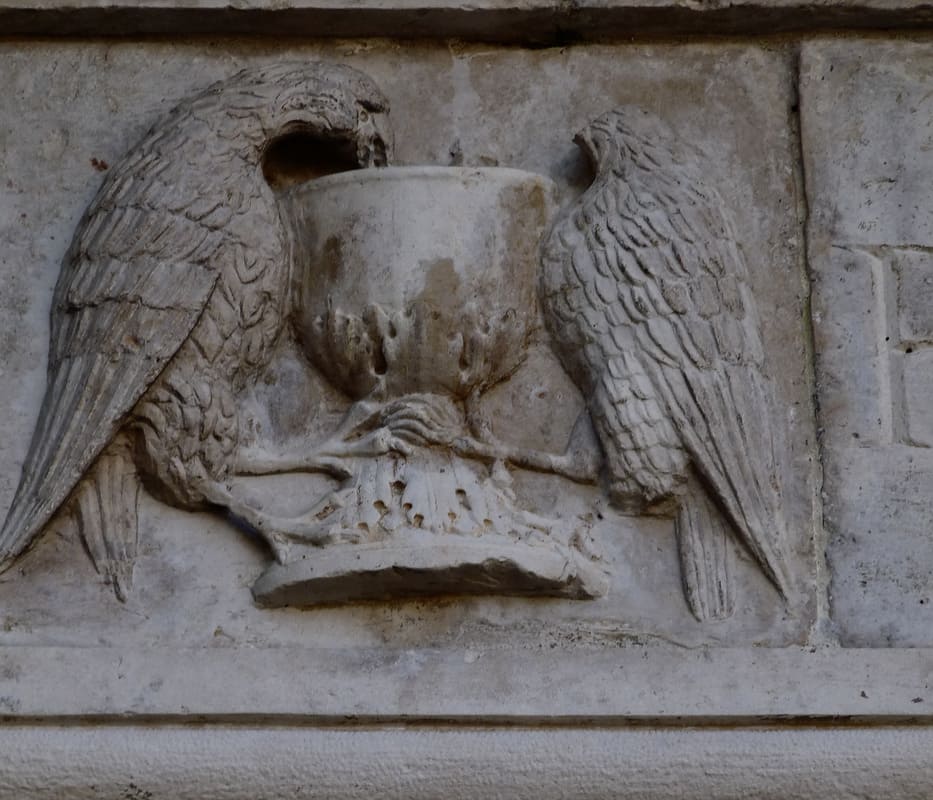
Around the age of 20 he converted to the Benedictine order, stayed in Spain, came back to Ravenna, and then eventually, around the Year 1000, ended up in Camaldoli, near Arezzo. There, he founded a branch of the Benedictines: the Camaldolese Order, to which he also added Eastern hermitage in addition to the Western Ora et Labora (pray and work). This union of Western and Eastern philosophy was reflected in the symbol of this Order: two doves drinking together from the same chalice.

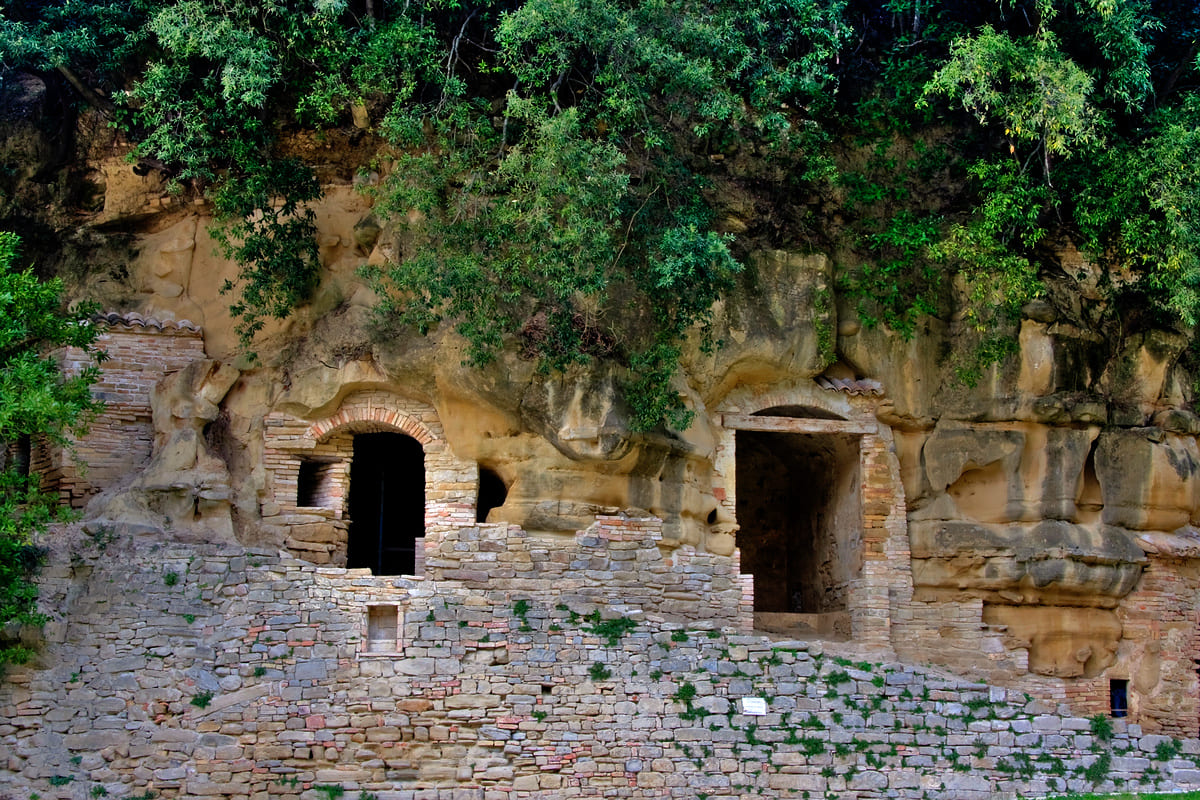
The Camaldolese monks therefore often built hermit caves, or hermit buildings, in addition to ordinary monasteries. For example, the Eremo dei Frati Bianchi in Cupramontana, where the first monks lived in cliff dwellings.

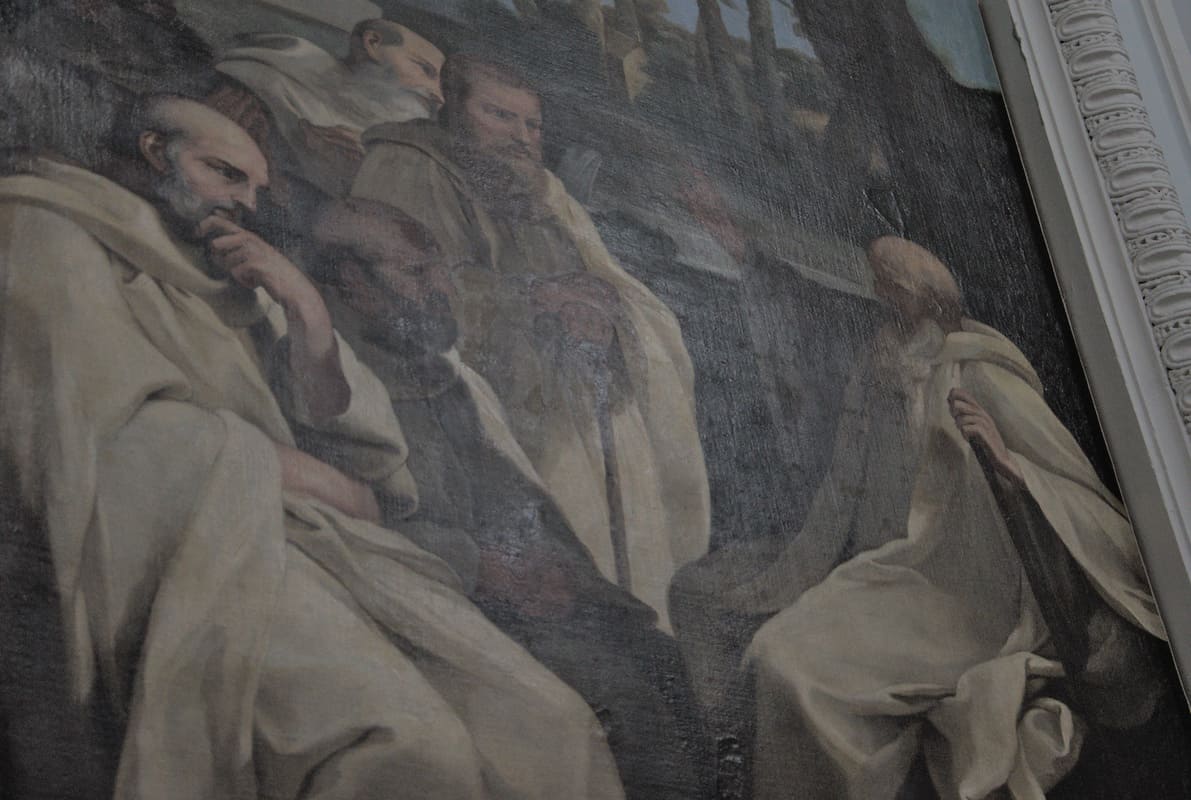
An 18th century copy of the painting The Apparition by Andrea Sacchi (17th century in the Vatican Museums) hangs in the San Leonardo Church in Cupramontana. Here San Romualdo is depicted as an elderly man in his white habit.

Romualdo then moved regularly in Umbria and Le Marche, where he died in 1027 in the abbey of Valdicastro.

In addition, a small community took the name of this saint: Poggio San Romualdo

He was canonized in 1595. But already in 1480 his body was already important. Two monks from Ravenna tried to smuggle Romualdo’s body from the Abbey of Valdicastro back to his hometown. But during their stop in Jesi, their plan was discovered. From then on, a whole battle started between Fabriano (to which Valdicastro belonged) and Jesi, because relics or better still bodies of clerics who were venerated, always attracted many pilgrims and of course meant income!

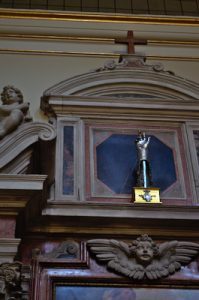
In the end, Fabriano received almost all of the body, with Jesi receiving part of the arm that can be seen in the Cathedral of Jesi.


This is how Romualdo ended up in the San Biagio church of Fabriano (13th-18th century), which was then called the Chiesa dei Santi Biagio e Romualdo

Source: https://eccolemarche.eu/en/blog/2023/02/04/the-controversial-relics-of-saint-romualdo/